
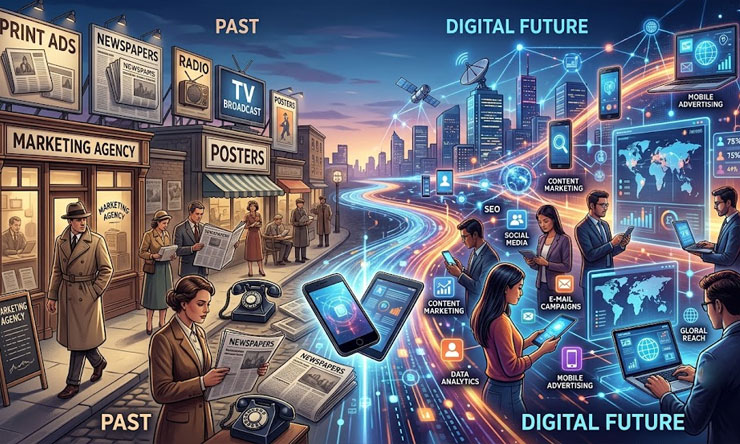
The digital era has fundamentally transformed the way businesses market their products and services. Traditional marketing methods, once dominated by television commercials, newspaper advertisements, radio broadcasts, and direct mail campaigns, have gradually evolved into sophisticated digital strategies powered by data, artificial intelligence, and online platforms. Today, businesses of every size have access to digital marketing tools that allow them to reach global audiences, personalize customer experiences, and measure campaign performance with remarkable precision. As consumer behavior continues to shift toward digital channels, businesses must adapt their marketing strategies to remain competitive and relevant.
The rapid growth of internet connectivity, smartphones, social media, and cloud computing has created new opportunities for businesses to connect with customers at every stage of the buying journey. Digital marketing is no longer just an additional promotional channel—it has become the foundation of modern business growth. Understanding the evolution of business marketing helps organizations appreciate how technology has reshaped customer engagement and provides valuable insights into the future of marketing in an increasingly connected world.
From Traditional Marketing to Digital Marketing
For decades, businesses relied on traditional marketing channels to build brand awareness and generate sales. Print advertisements, billboards, television commercials, and radio promotions were among the primary methods used to reach consumers.
While these channels were effective, they also had several limitations:
- High advertising costs
- Limited audience targeting
- Difficult performance measurement
- One-way communication
- Slow campaign adjustments
The rise of the internet changed this landscape dramatically. Businesses gained the ability to communicate directly with consumers through websites, email, and online advertising.
Digital marketing introduced several key advantages:
- Lower marketing costs
- Global audience reach
- Real-time performance tracking
- Personalized messaging
- Two-way customer interaction
This shift marked the beginning of a more data-driven and customer-focused approach to marketing.
The Rise of Search Engine Marketing
Search engines have become one of the most important channels for connecting businesses with potential customers.
Consumers now search online before making purchasing decisions, comparing products, reading reviews, and researching brands.
Businesses have responded by investing in:
- Search Engine Optimization (SEO)
- Pay-Per-Click (PPC) advertising
- Local search optimization
- Voice search optimization
- Content marketing
SEO helps businesses improve their visibility in organic search results by creating valuable, relevant, and optimized content.
PPC advertising allows companies to display targeted ads to users actively searching for specific products or services.
Search engine marketing has become essential because it reaches customers with high purchase intent, making it one of the most effective digital marketing strategies.
Social Media Changes Customer Engagement
Social media has revolutionized how businesses communicate with customers.
Platforms such as Facebook, Instagram, LinkedIn, X (formerly Twitter), TikTok, and Pinterest allow brands to engage with audiences in real time rather than relying solely on traditional advertising.
Businesses use social media to:
- Build brand awareness
- Share educational content
- Launch products
- Provide customer support
- Gather customer feedback
- Build online communities
- Run targeted advertising campaigns
Unlike traditional media, social platforms encourage interaction.
Customers can comment, share content, ask questions, and participate in discussions, creating stronger relationships between businesses and their audiences.
Social media analytics also provide valuable insights into customer preferences, helping businesses continuously refine their marketing strategies.
Content Marketing Becomes a Growth Strategy
As digital competition increased, businesses realized that promotional advertising alone was no longer enough.
Consumers began seeking valuable information before making purchasing decisions.
This shift gave rise to content marketing.
Businesses now produce various forms of content, including:
- Blog articles
- Educational videos
- Podcasts
- Infographics
- Case studies
- White papers
- Webinars
- Email newsletters
High-quality content helps businesses:
- Demonstrate expertise
- Build customer trust
- Improve SEO rankings
- Generate qualified leads
- Increase website traffic
- Support long-term brand authority
Rather than focusing only on selling products, content marketing emphasizes solving customer problems and providing useful information.
This approach builds stronger relationships and encourages customer loyalty over time.
Personalization Through Data and Artificial Intelligence
One of the defining characteristics of digital marketing is personalization.
Businesses now collect and analyze customer data to deliver highly relevant marketing experiences.
Artificial intelligence (AI) and machine learning enable marketers to personalize:
- Product recommendations
- Email campaigns
- Website experiences
- Advertising content
- Promotional offers
- Customer support interactions
For example, e-commerce platforms recommend products based on browsing history and previous purchases.
Streaming services suggest content tailored to individual viewing preferences.
AI-powered marketing automation also enables businesses to send personalized messages at the right time through the most appropriate communication channel.
Personalization increases customer satisfaction while improving conversion rates and marketing efficiency.
Marketing Automation Improves Efficiency
Marketing automation has become one of the most valuable innovations in digital marketing.
Businesses automate repetitive marketing activities such as:
- Email campaigns
- Social media scheduling
- Lead nurturing
- Customer segmentation
- Performance reporting
- Campaign optimization
Automation reduces manual workloads while ensuring consistent communication with customers.
Modern marketing platforms also integrate customer relationship management (CRM) systems, allowing sales and marketing teams to collaborate more effectively.
Automated workflows help businesses respond quickly to customer actions, increasing engagement without requiring constant human intervention.
As organizations grow, marketing automation supports scalability by enabling teams to manage larger audiences efficiently.
Data Analytics Drives Smarter Marketing Decisions
Digital marketing provides access to an unprecedented amount of performance data.
Businesses can monitor key metrics including:
- Website traffic
- Conversion rates
- Customer acquisition costs
- Return on advertising spend
- Engagement rates
- Email open rates
- Customer lifetime value
Marketing analytics enables organizations to evaluate campaign effectiveness in real time.
Instead of waiting weeks or months for results, marketers can quickly identify successful strategies and adjust underperforming campaigns.
Predictive analytics further enhances decision-making by forecasting customer behavior and identifying future opportunities.
Data-driven marketing reduces uncertainty and helps businesses maximize the return on their marketing investments.
The Growing Importance of Mobile Marketing
The widespread adoption of smartphones has significantly influenced marketing strategies.
Consumers increasingly browse websites, shop online, watch videos, and interact with brands using mobile devices.
Businesses now prioritize:
- Mobile-friendly websites
- Responsive web design
- Mobile applications
- SMS marketing
- Mobile advertising
- Location-based marketing
A positive mobile experience improves customer satisfaction and supports higher search engine rankings.
Mobile payment systems and digital wallets have also simplified online purchasing, encouraging businesses to optimize every stage of the customer journey for mobile users.
As mobile usage continues to grow worldwide, mobile-first marketing has become an essential business strategy.
Challenges in Digital Marketing
Despite its many advantages, digital marketing also presents several challenges.
Increasing Competition
The low barriers to entry mean businesses compete with organizations from around the world.
Standing out requires continuous innovation and high-quality content.
Privacy Regulations
Businesses must comply with evolving data protection laws and respect customer privacy when collecting and using personal information.
Transparent data practices build consumer trust.
Rapid Technology Changes
New platforms, algorithms, and technologies emerge regularly.
Businesses must continuously adapt their marketing strategies to remain effective.
Managing Multiple Channels
Customers interact with brands across websites, social media, email, search engines, and mobile apps.
Maintaining a consistent customer experience across all channels requires careful coordination and integrated marketing strategies.
The Future of Business Marketing
Digital marketing continues to evolve alongside technological innovation.
Emerging trends include:
- AI-powered content creation
- Voice search optimization
- Augmented reality shopping experiences
- Predictive marketing analytics
- Conversational marketing
- Video-first content strategies
- Hyper-personalized customer experiences
- Privacy-focused marketing
Artificial intelligence will continue to automate marketing processes while improving personalization and campaign performance.
Businesses that embrace innovation while maintaining authentic customer relationships will be better positioned for long-term success.
Future marketing strategies will increasingly focus on creating meaningful customer experiences rather than simply delivering advertisements.
Conclusion
The evolution of business marketing in the digital era has transformed how organizations connect with customers, promote their brands, and drive sustainable growth. Digital technologies have shifted marketing from broad, one-way communication to personalized, data-driven engagement across multiple online channels. Search engine optimization, social media, content marketing, artificial intelligence, automation, and analytics have become essential components of successful marketing strategies, enabling businesses to improve efficiency and deliver greater value to their audiences.
As technology continues to advance, the future of business marketing will be shaped by innovation, adaptability, and customer-centric thinking. Companies that invest in digital capabilities, leverage data responsibly, and embrace emerging technologies will be better equipped to compete in an increasingly connected global marketplace. The evolution of digital marketing is far from over, and businesses that continuously adapt will be best positioned to achieve long-term growth and lasting customer loyalty.