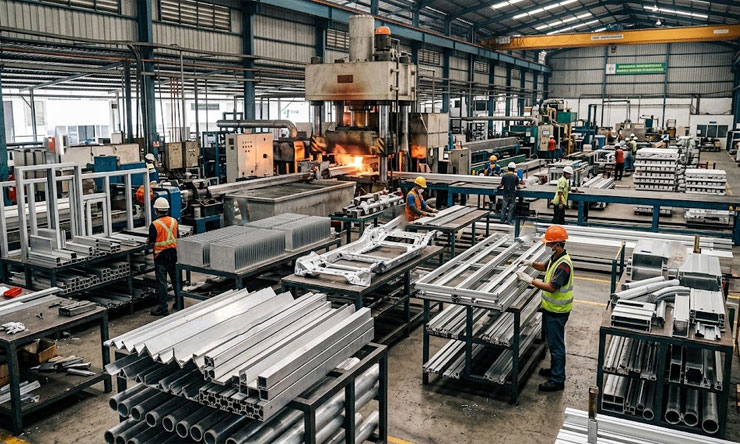
Aluminum extrusion forces a heated billet through a shaped steel die, so the profile leaves the press with its final cross-section already formed. Mild steel rarely works that way, since most steel sections are cut, bent, or welded from separate parts before reaching a usable shape. That single-step forming is one reason procurement teams source finished profiles from Indonesia extruded aluminum manufactures instead of machining sections from raw stock. Aluminum also weighs roughly one-third as much as steel and develops a protective oxide layer on its own, removing the galvanizing step carbon steel usually requires before shipment.
PT Exalum Metal Indo runs its extrusion facility in Tangerang, Indonesia, supplying architectural and industrial profiles to domestic and export customers. Reviewing the current catalog of Exalummetal industrial aluminum products shows why many buyers specify standard sections instead of funding custom tooling. The factory maintains a large library of existing dies, so a section ordered this quarter matches the one ordered last year in dimension and finish, which protects assembly-line compatibility across repeat production runs.
Six profiles account for most of what leaves an extrusion factory for industrial use. Each is identified by a section number, a fixed catalog reference that stays the same on every reorder.
1. Flat Bar
Flat bar is the general-purpose stock a fabrication shop cuts into mounting strips, machine base plates, spacers, and structural reinforcement. Section 10040 measures 50 mm wide by 5 mm thick at 0.678 kg per metre, while section 10083 runs 38 mm by 19 mm with a 2 mm radius at 1.947 kg per metre. Orientation matters more than most buyers expect: standing a bar on its narrow edge raises bending resistance sharply compared with laying it flat. Widths run from 10 mm to 100 mm across the catalog.
2. Conveyor Profile
Conveyor profile, known in North America as T-slot extrusion, carries continuous slots along its faces so brackets, panels, and sensors mount with T-nuts instead of drilling or welding. Section 70330 is a single-slot rail with a 1.20 mm wall at 0.647 kg per metre; section 70015 is a double-slot rail with a 2.50 mm wall at 1.764 kg per metre. For an OEM that reconfigures production lines, the value is rebuilding a frame without hot work. Single and double slot variants are listed separately on the Exalum catalog.
3. Equal Angle
Equal angle reinforces corners wherever two surfaces meet at 90 degrees, from rack frames and machine guards to panel edge protection in high-traffic plants. Sections 20047 and 20046 both carry a 19 mm leg but differ in wall, 1.00 mm against 1.20 mm, weighing 0.100 and 0.120 kg per metre. That 0.20 mm gap is a separate die, letting a buyer size for actual load instead of shipping surplus weight on every container. Extruded angle also avoids the work-hardened bend line that folded sheet leaves behind.
4. Rectangular Hollow
Rectangular hollow section resists torsional twisting in a way open profiles cannot, which suits cantilevered arms, gates, canopy framing, and machine guarding. Section 45140 is 40 by 20 mm in a 1.20 mm wall at 0.380 kg per metre, and section 45204 steps up to 100 by 50 mm in a 2.50 mm wall at 1.962 kg per metre. Extruded through a porthole die, the walls close without a welded seam, so there is no weld line to fail under repeated load.
5. Unequal Channel
Unequal channel, sometimes listed as C channel, guides moving parts along one axis while retaining them on the other, most often as sliding tracks for partitions and glazed screens. Section 32042 is 50.80 mm deep against a 12.70 mm web in a 0.90 mm wall at 0.182 kg per metre. The asymmetric flanges are deliberate: the longer leg holds fasteners on the concealed side while the shorter one keeps a slim sightline. Folding that geometry accurately from sheet is difficult; a die repeats it identically.
6. Heatsink
Heatsink profiles pull heat from LED drivers, inverters, and telecom hardware by exposing as much fin surface as possible to moving air. Section 96004 runs a 1.00 mm wall at 0.378 kg per metre, while section 96001 carries 1.25 mm fins at 0.799 kg per metre, trading weight for better sustained conduction. Fin geometry options and full section dimensions are published on the Exalum product pages.
Standard profiles stay the preferred route for most manufacturers because the dies already exist, lead times are shorter, and dimensions hold steady across every production run. Selecting between them depends on load, fabrication method, and finish, which makes early specification worth the time.
Requesting a Quotation
If your project requires aluminum extrusion profiles in production quantities, Exalum Metal supplies volume orders from Indonesia to the United States, the United Kingdom, Australia, Canada, and other industrial markets. Send your profile drawing or section number, required cut lengths, estimated order volume, and finishing specification such as anodizing or powder coating to [email protected] or WhatsApp +62 811 9429 970. Custom die development is available for projects that need a non-standard profile.